
Flexographic Printing
Controlled ink delivery for consistent density and print reproduction.
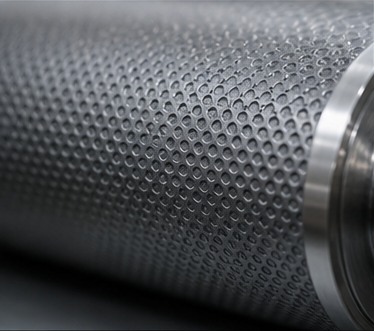
Anilox rollers meter a defined volume of ink, coating or adhesive through precisely engraved cells. Cell geometry, volume, line count and release behavior determine transfer consistency.
Request Technical Discussion +Anilox rollers meter a defined volume of ink, coating or adhesive through precisely engraved cells. Cell geometry, volume, line count and release behavior determine transfer consistency.
Each application has different material behavior, operating conditions and surface expectations. The roller specification is developed accordingly.
Controlled ink delivery for consistent density and print reproduction.
Metered application of varnish, adhesive and functional coatings.
Application-specific cell structures for technical fluids and surface treatments.
Cell volume and geometry are selected around viscosity, coverage and transfer target.
Consistent engraving supports stable coating weight across the working face.
Cell shape and surface condition influence filling, release and cleaning behavior.
Specifications can be developed with ink, coating and press parameters.
Final dimensions and materials are confirmed against the approved drawing and operating data.
| Key parameters | Cell volume, line count, cell angle, geometry and face width |
|---|---|
| Applications | Ink, varnish, adhesive and functional coating transfer |
| Design inputs | Viscosity, solids, target coat weight, speed and substrate |
| Surface focus | Cell consistency, clean release and wear resistance |
| Inspection | Cell structure, volume consistency, dimensions and surface condition |
We review the material, machine arrangement and performance target for this roller.
Roll geometry, surface specification and process parameters are defined for anilox rollers.
Machining, engraving or polishing is completed under dimensional process control.
The finished roller is checked, protected and prepared for domestic or export delivery.
Selection depends on coating type, particle size, desired transfer volume, print detail and cleaning conditions.
It controls how much liquid the roller can carry and transfer during each revolution.
Yes, provided the required cell data, application parameters or a measurable reference roller is available.
Share the material, working width, roller drawing and desired surface result for a technical review.